
Should You Buy a Domain for Every Startup Idea? The Hoarding Trap
You have a great idea in the shower, find the .com is free, and register it before the feeling fades. Ten ideas later you own ten domains, you are building none of them, and you are paying for all of them every year. Domain hoarding feels like cheap insurance. In practice it is a quiet tax on your focus. Here is how to decide which names deserve a purchase, and which only deserve a note.
Добавьте ZeroTaken в избранные источники Google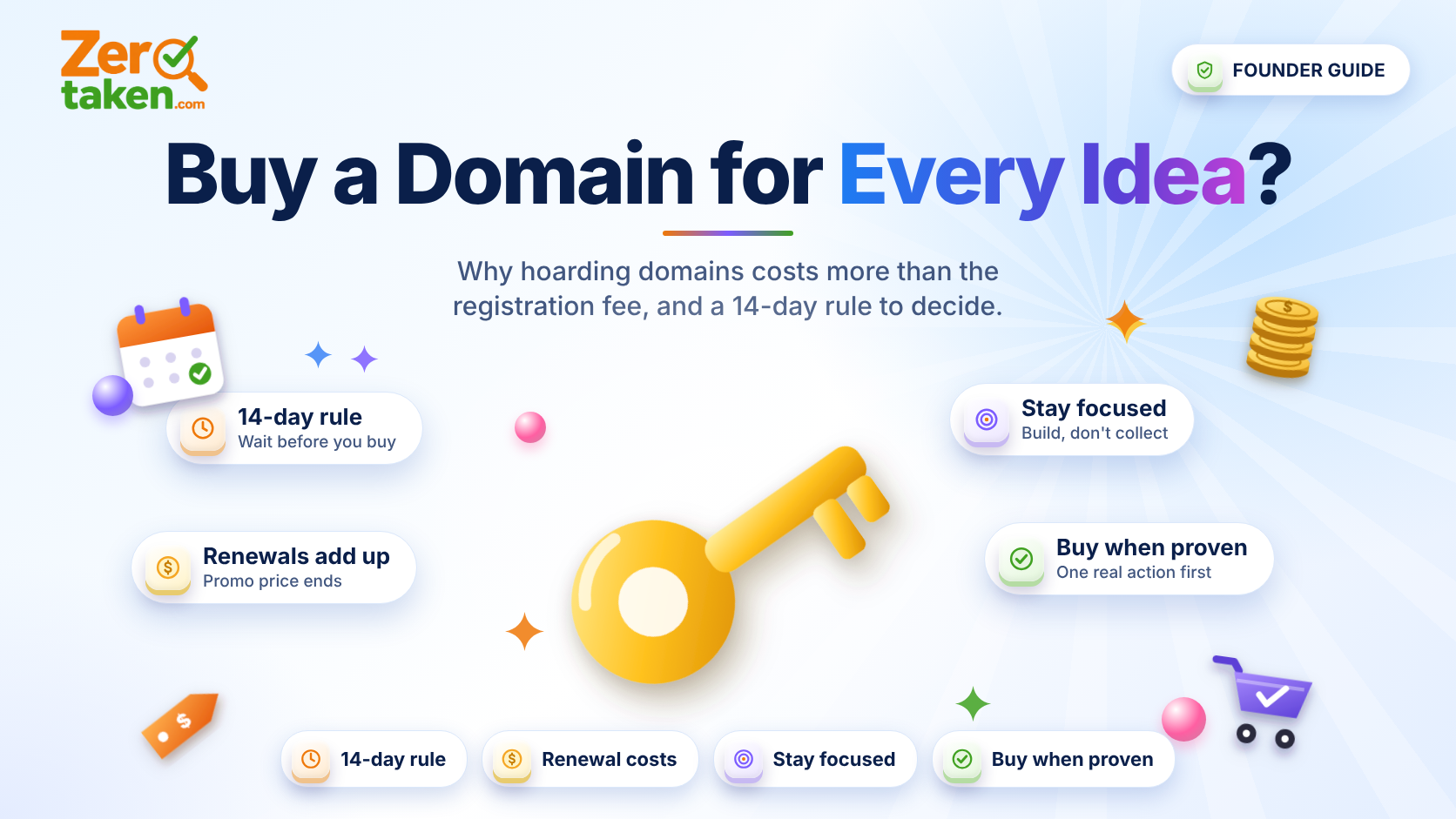
Why does buying a domain for every idea feel so smart?
Because the cost of a single registration is small and the fear of losing the name is large. Scarcity does the rest: a clean, short .com looks like it could vanish tomorrow, so buying feels like winning something.
The trap is that the purchase gives you the feeling of progress without any of the work. A registered domain is not a customer, a prototype or a validated problem. It is a receipt.
What does hoarding actually cost you?
The registration fee is the smallest part. Many registrars price the first year low and renew at a noticeably higher rate, so a drawer full of cheap first-year domains turns into a recurring bill. Add privacy add-ons, and the quiet cost compounds.
The bigger cost is attention. Every domain is something to renew, point somewhere, and keep track of. Lapsed ones can be picked up by someone else, and old names that once pointed at nothing can still attract spam or phishing attempts against your brand if you let them go carelessly.
The biggest cost is psychological. Owning the domain makes an idea feel decided. You start defending a name instead of testing a problem.
- Renewal prices usually exceed the promo first-year price
- Each domain is another expiry date and DNS record to manage
- A purchased name creates commitment bias before any validation
- Dropped domains can be re-registered by strangers
When is buying the domain immediately the right call?
Buy right away when the idea has passed a real filter, not a feeling. Three signals count: you have talked to potential users about the problem, you are committed to spending the next few weeks building or testing it, and the name itself passed a basic sanity check (easy to spell, easy to say, no obvious trademark conflict).
If all three are true, the domain is part of launching, not hoarding. Register it, set auto-renew, and move on.
What should you do with ideas that have not earned a domain yet?
Write them down. Keep a simple idea list with the name, a one-line problem statement, and the date. Re-read it in two weeks. Ideas that still excite you after a cooling-off period are candidates; the rest cost you nothing.
If you worry a name will be taken in the meantime, treat that as a data point. A name you would not be willing to rebuild around if it vanished is not a name worth paying to hold.
When you do want to check status before deciding, run the name through a live availability check such as ZeroTaken rather than guessing. Checking is free; owning is the commitment.
Is there ever a case for owning a small portfolio?
Yes, but make it a short, deliberate list. Owning the main brand name plus one or two close variants (a common misspelling, or the same name on a second extension) is defensive and sensible once the brand is real. That is brand protection, a different thing from collecting unbuilt ideas.
A useful cap: one domain per project you are actively working on, plus a defensive variant only after launch. Anything beyond that needs a written reason.
What is a simple rule you can follow starting today?
Use the 14-day rule. Note the idea, wait two weeks, and buy only if you have taken one concrete action on it in that time: a user conversation, a landing-page draft, a prototype. No action, no domain.
Then audit what you already own. For each domain ask whether you would pay the renewal price today to start that project this month. If the answer is no, let it expire on purpose, and write down the lesson. Fewer domains, more shipped work.