
Do You Need a Branded Short-Link Domain? What to Know Before You Buy One
Every founder eventually pastes a link into a tweet, a text message or a printed flyer and wonders: should this say go.yourbrand.com, a tiny dedicated domain, or just a long URL on the main site? A branded short-link domain is one of the cheapest brand assets you can add, and also one of the easiest to get wrong. Get it right and every shared link advertises your name. Get it wrong and you have a second domain to renew, a blocklist risk, and links that break the day you switch tools. This guide gives you a clear rule for when to buy one and how to pick it.
Добавьте ZeroTaken в избранные источники Google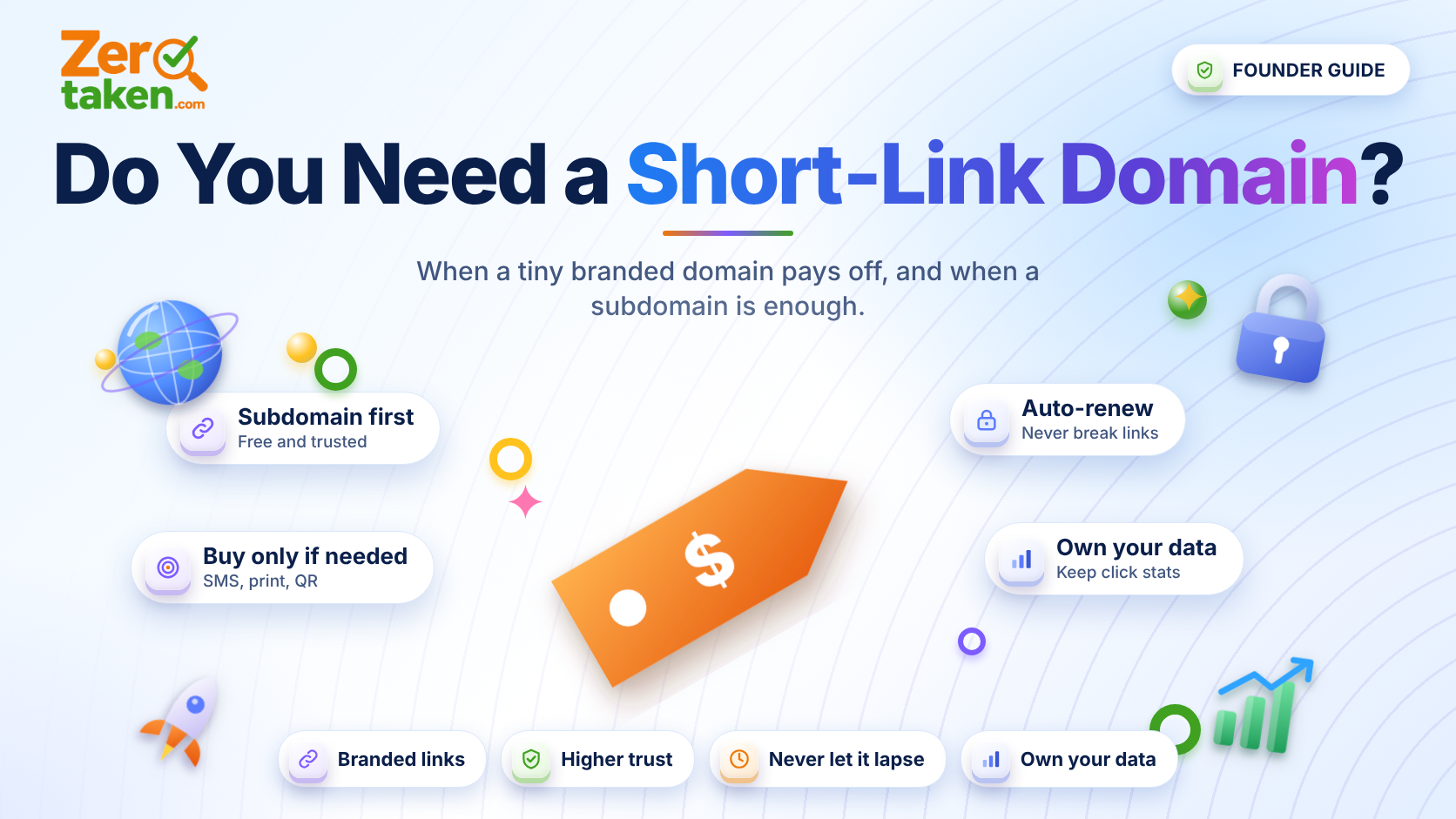
What is a branded short-link domain, and why does it exist?
A branded short-link domain is a separate, usually very short domain that redirects to your real pages, such as a three-to-six letter name on a short extension. Instead of a link on a generic shortener you share one on a domain people can tie to you.
The reason it exists is trust and control. A link on a shared public shortener tells the reader nothing, and those domains are heavily abused, so some filters and wary users treat them with suspicion. A link on your own domain shows who is sending it, lets you keep the click data, and keeps working if you change analytics tools.
When is a short-link domain actually worth buying?
Buy one when links are a real part of your distribution, not because it feels professional. The test is simple: do you share more than a few dozen links a month in places where length or trust matters?
If your links mostly live in clickable blog posts and emails, a path on your main domain is enough and it keeps all link equity in one place.
- Worth it: SMS and WhatsApp campaigns, printed material and QR codes, podcast and video show notes, social bios, and affiliate or creator programs.
- Worth it: you run many campaign links and want per-link tracking you own.
- Skip it: you share a handful of links a month, or only inside your own website and newsletter.
- Skip it: you have not yet settled your main brand name. A short domain built around a name you later change is wasted.
Should it be a subdomain, a subfolder or a separate domain?
You have three options, and the cleanest default for most teams is a subdomain of the main domain, such as go.yourbrand.com. It costs nothing extra, inherits brand recognition instantly, and cannot be confused with a lookalike.
A separate short domain wins only when characters genuinely matter: SMS length, printed codes, a tight social bio, or a spoken URL. In those cases the short domain earns its keep. A subfolder like yourbrand.com/go is the lowest-effort choice and is fine when you do not need tracking separate from your site.
- Subdomain (go.yourbrand.com): best default. Free, trusted, easy to set up.
- Separate short domain: best when every character counts or links are spoken and printed.
- Subfolder (yourbrand.com/go): simplest, but ties redirects to your website stack.
How do you pick a good short domain?
The brand name should still be recognisable at a glance. A short domain that is a clipped, unrelated string wastes the trust you are paying for. Aim for your brand name abbreviated sensibly, or the brand name plus a short extension that reads as part of the word.
Apply the same radio test you would to a main domain: could someone type it correctly after hearing it once? Avoid ambiguous letters, doubled characters and hyphens, because short links are the ones people most often read aloud or type by hand.
Be careful with extensions that spam filters distrust. Some inexpensive or novelty extensions are blocked by corporate firewalls and email filters more often than .com, and a link that never reaches the reader is worse than a long one. Prefer a mainstream extension, or a country extension you have a real tie to.
What can go wrong with a short-link domain?
Most failures are operational, not creative. A short link is a promise that it will keep working, so the domain must never lapse. Printed material and old social posts can outlive a campaign by years.
The second risk is lock-in. If your shortener tool hosts the redirects, switching tools can orphan every link you ever shared. Make sure you can export your link table, and keep the DNS under your own registrar account rather than the tool's.
The third is reputation. If anyone ever uses your short domain to redirect to something abusive, browsers and filters can flag the whole domain. Limit who can create links, and do not leave an open redirect that accepts any destination.
- Turn on auto-renew and register for several years up front.
- Keep registrar access with your company, not an individual or a vendor.
- Restrict link creation and block arbitrary destinations.
- Redirect the bare root of the short domain to your main site so nothing looks abandoned.
How do you check a short-link domain before you commit?
Short names are scarce, so expect to try several. Check each candidate for availability across a few extensions, then run the basics: say it aloud, search the string to see what already uses it, and confirm it does not spell something unfortunate when attached to your brand.
A tool like [CTA_BANNER] makes it quick to test a batch of short candidates in one go instead of one at a time.
Decide your fallback before you start. If the ideal short domain is taken, the subdomain option costs nothing and is never the wrong answer.
So what is the verdict?
Start with go.yourbrand.com. It is free, trusted and reversible. Move to a dedicated short domain only when you can point to a concrete place where characters or trust are costing you clicks, such as SMS, print or spoken URLs.
When you do buy one, treat it like production infrastructure: mainstream extension, multi-year registration, auto-renew, and registrar access owned by the company. A short domain is a small purchase that should never become a small outage.