
.ai vs .io: Which Should an AI Startup Actually Pick in 2026?
You've accepted that the .com is gone — squatted since 2019, or parked behind a five-figure "make an offer" page. Now you're an AI founder staring at the two extensions everyone in your space actually uses: .ai and .io. Both are country-code domains wearing a tech costume, both cost several times more than a .com, and picking wrong means either overpaying for a decade or rebranding at your Series A. This guide skips the "it depends" non-answer: here's how .ai and .io really differ on signal, cost, risk, and availability, and a rule for choosing in under a minute.
Добавьте ZeroTaken в избранные источники Google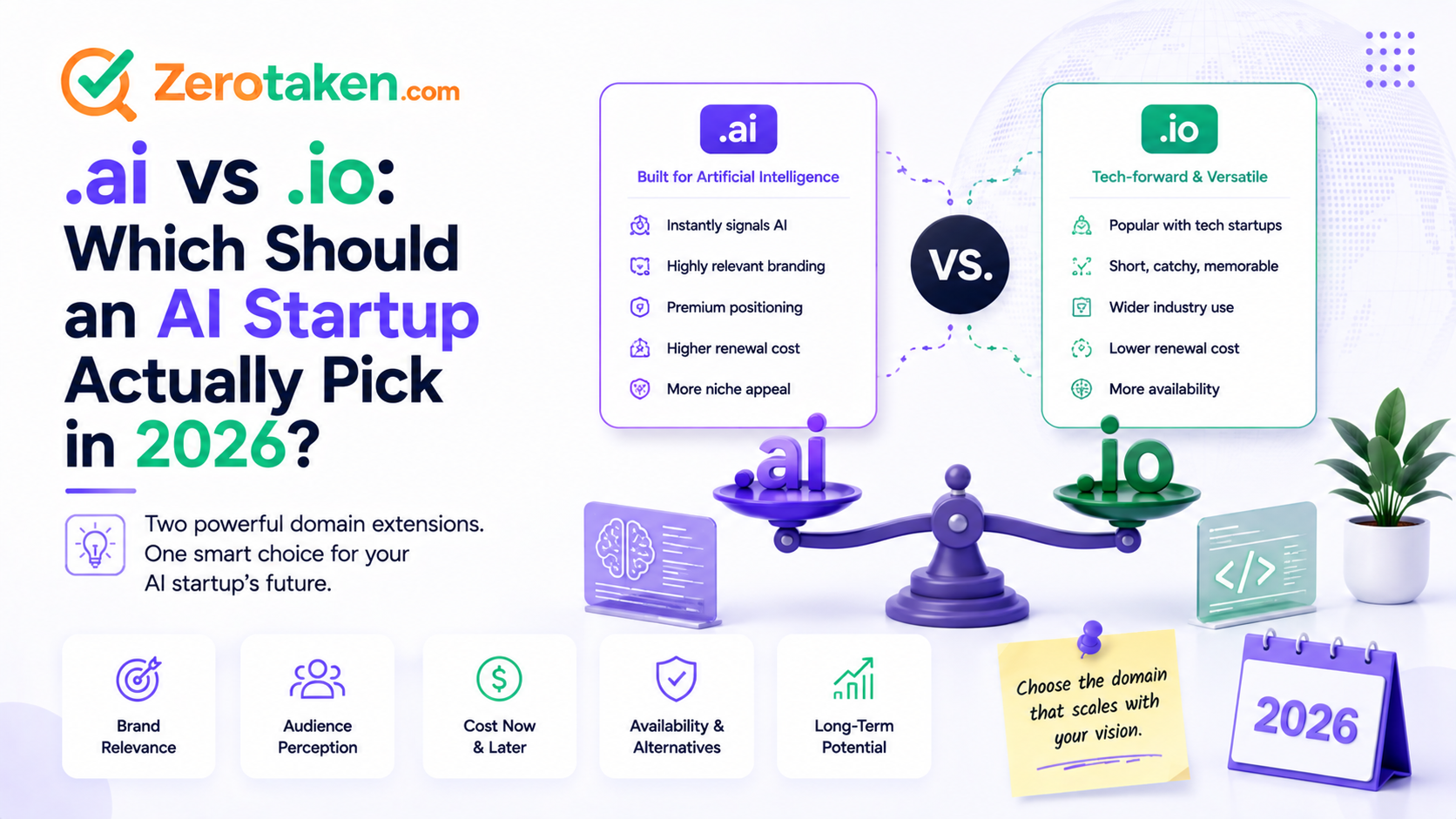
Why are AI startups even choosing between .ai and .io?
.ai and .io are not "new extensions" — they're country codes. .ai belongs to Anguilla, a Caribbean island of about 15,000 people; .io belongs to the British Indian Ocean Territory. Developers adopted .io a decade ago because it reads like "input/output," and the AI wave did the same thing to .ai, which happens to spell the exact thing every founder in the space is building. Neither was designed for startups. Both were quietly repurposed by them.
That history explains everything else on this page: the high prices (tiny registries charge what the market will bear), the occasional geopolitical wrinkle, and the fact that your name is far more likely to be free here than on .com. When you shop for a .ai or a .io, you're in a boutique, not a supermarket — smaller shelves, higher tags, but the thing you want is actually in stock.
What does each extension actually signal to a visitor?
.ai is the most on-the-nose domain in tech right now. It tells a visitor "this is an AI product" before they read a single word. That's a gift if you're building a model, an agent, or an AI-native app — and a quiet liability if you're not, because in a few years ".ai" may read like a timestamp of the hype cycle you launched in, the way a 2011 startup on a ".ly" URL shortener domain reads today.
.io signals "developer tool" or "technical platform." It's calmer, and it has aged remarkably well over ten-plus years — nobody looks at a .io and thinks it's dated. If your product is infrastructure, an API, a dev tool, or anything sold to engineers, .io carries far less risk of looking like a trend-chaser than .ai does.
- .ai — "we are an AI company." Loud, current, ideal for AI-native products; risks reading as a hype-cycle timestamp later.
- .io — "we build technical/developer products." Neutral, durable, safe for infrastructure and tools.
- Neither says "trustworthy store" to a non-technical consumer — if you sell to mainstream shoppers, both can feel unfamiliar and a .com or .co is worth fighting for.
Which one is more expensive to own — and does it matter?
Both cost far more than a .com's roughly $10–15 a year, but they're not priced alike. A .io typically runs about $35–65 per year. A .ai is pricier and comes with a catch: Anguilla's registry requires a minimum two-year registration, so you pay for two years up front — usually somewhere around $60–110 for that block — and you renew in two-year chunks at a similar rate.
For a funded startup, that's rounding error. For a bootstrapper it's a real line item: over five years a .ai can quietly cost more than $250 while the equivalent .com would be under $75. The mistake isn't paying it — it's forgetting it. Premium-priced country-code domains are exactly the ones founders let lapse, because the renewal invoice lands at 5–10× what a normal .com trained them to expect. If you buy one, put it on a card that won't expire and switch on auto-renew the same day.
Is .io a riskier long-term bet than .ai?
This is the one place the two genuinely diverge on risk. In 2024 the UK agreed to hand sovereignty of the Chagos Islands — the British Indian Ocean Territory — to Mauritius. Because .io is that territory's country code, people reasonably asked whether the extension could eventually be retired, the way .su and .yu were when their countries left the international standard. .ai has no equivalent question: Anguilla is a stable British Overseas Territory that isn't going anywhere.
The honest read is that nothing happens to .io overnight. Retiring a country-code domain is a multi-year, ICANN-governed process, and .io has millions of registrations and real revenue behind keeping it alive — a powerful incentive for whoever administers it to negotiate its survival. But "almost certainly fine" is not "guaranteed forever." If you're choosing the domain for a ten-year brand and this uncertainty genuinely nags at you, that's a legitimate reason to lean .ai — or to hold the matching .com as insurance. For most founders shipping this year, it should not be the deciding factor.
Do .ai or .io hurt your SEO?
No — not for a global product. The extension is not a ranking factor. Google ranks pages, not the letters after the dot, and plenty of the tools you use every day rank perfectly well on .io and .ai. Your domain string won't move you up or down the results.
The only real nuance with country-code domains is geo-targeting: a true ccTLD can be associated with its home country, which is irrelevant if you sell worldwide and only a mild concern if you're chasing one specific national market that happens not to be Anguilla or the Indian Ocean. If you're a global SaaS or AI product — which is basically everyone reading this — treat SEO as a non-issue and decide on signal, cost, and availability instead.
Which one is your name actually available on?
This is where both extensions earn their keep. The whole reason you're here is that the .com is taken — and on .ai and .io, the same name is dramatically more likely to be open, because the total pool of registrations is a tiny fraction of .com's. A clean one-word name that's been gone on .com since 2011 is often still free on one or both.
The catch: .ai in particular has been picked over hard since 2023, so the obvious AI words — chat, agent, mind, neural — are largely registered or squatted. The right move is to check your whole shortlist across both extensions at once instead of falling in love with a single name on a single TLD. ZeroTaken checks .ai and .io side by side with live registry data, so you see the real picture before you get attached. [CTA_BANNER]
Whatever you do, don't check them one at a time in a registrar's search box — it's built to nudge you toward whatever upsell it's paid to push, not to give you a clean comparison. Run your five favorite names across both extensions together and let availability, not the sales funnel, break the tie.
So which should you actually pick?
Here's the rule. If you're building an AI-native product — a model, an agent, an AI-first app — and the .ai is available and you can absorb the renewal cost, take the .ai. Nothing else communicates what you do as instantly, and that clarity is worth the premium while the category is this hot.
If you're building developer tooling, infrastructure, an API, or a technical platform that isn't strictly "an AI company," take the .io. It's cheaper, it has aged gracefully, and it won't read like a time capsule in 2030 — the sovereignty asterisk notwithstanding.
And if the same strong name is free on both? Buy the one that matches what you are, and grab the other as a defensive redirect if the budget allows. What you should never do is settle for a weak, forgettable name on your favorite extension when a great name is sitting open on the other. The name matters far more than the letters after the dot — pick the best name first, then let this guide break the tie.