
Should Your Domain Name Have a Hyphen or a Number?
You found the perfect name. The .com is taken. And now you're staring at two tempting escape hatches: slip a hyphen between the words, or swap in a number. Both are one keystroke away from a domain that's finally 'available' — and both are decisions you'll quietly regret every single time you say your URL out loud. Here's the honest, opinionated answer on hyphens and numbers in domain names: why they usually backfire, the narrow cases where one is defensible, and what to reach for instead.
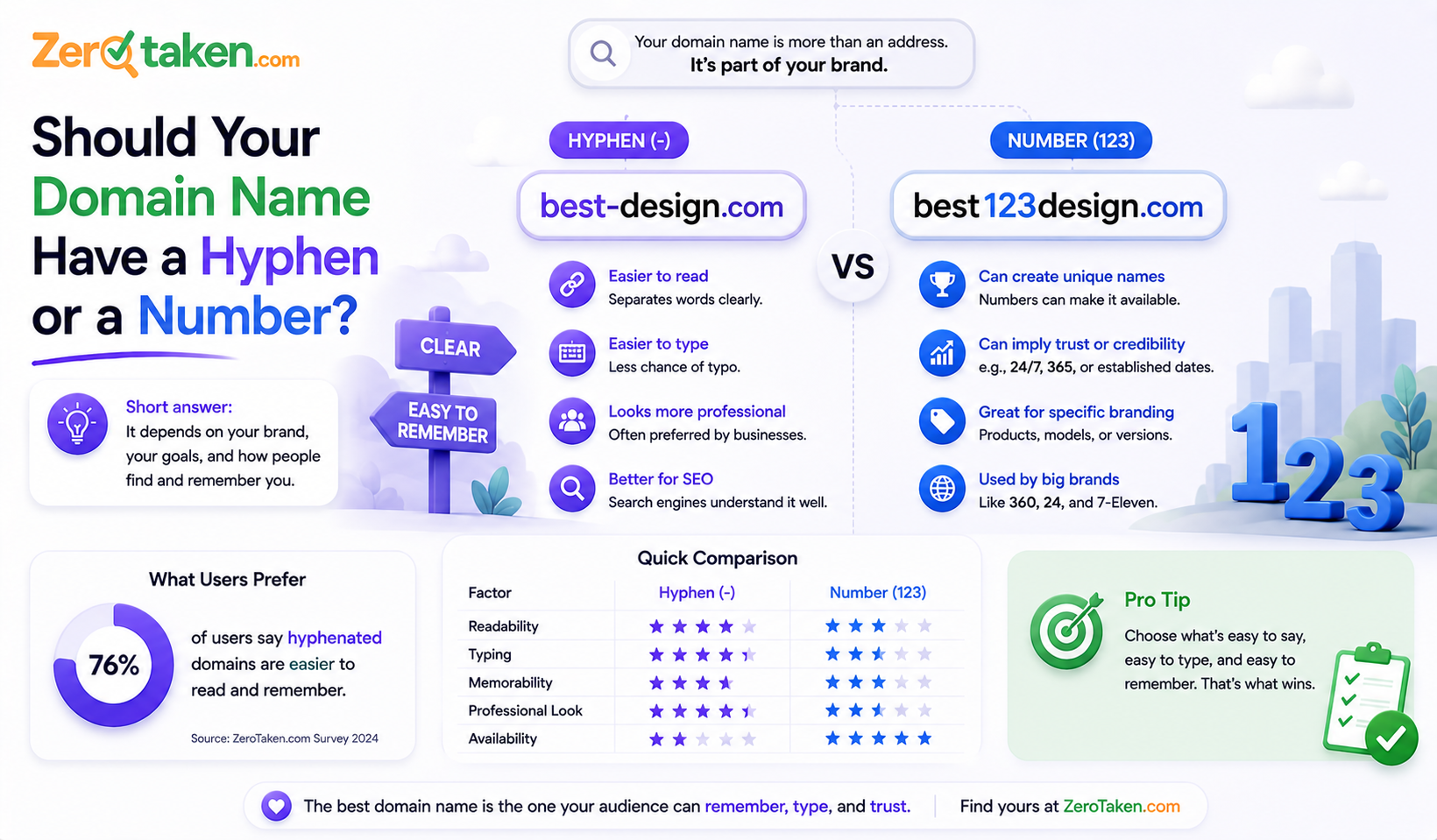
Are hyphens and numbers even allowed in a domain name?
Yes. A domain label can contain letters (a–z), digits (0–9), and hyphens. The only hard rules are that it can't start or end with a hyphen, and it can't be longer than 63 characters. So technically, my-app-2.com is a perfectly legal domain, and a registrar will happily sell it to you in about ten seconds.
But 'allowed' and 'advisable' are two very different questions. The registrar doesn't care whether your customers can remember, spell, or say your domain — that's your problem. And on that test, hyphens and numbers fail far more often than founders expect.
Why do hyphens quietly sabotage a domain?
A hyphen looks harmless on screen. The damage shows up everywhere the domain leaves the screen — in conversation, on a podcast, in a customer telling a friend about you.
The core problem is that you now have to pronounce punctuation. Say it out loud: 'It's pay-flow dot com — that's pay, hyphen, flow.' Nobody delivers that cleanly, and most people just drop the dash. That's not a minor annoyance; it's a permanent tax on every referral you'll ever earn.
- Lost traffic: if your domain is pay-flow.com, a big share of word-of-mouth visitors will type payflow.com. If someone else owns the un-hyphenated version, you're funneling your own customers straight to them.
- The spam association: hyphen-stuffed domains (best-cheap-car-insurance-quotes.com) were the calling card of 2000s SEO spam. That downmarket reputation still lingers for savvy users.
- The typo tax: every hyphen is one more thing to fumble in an email address, on a business card, or when a customer reads your URL to a colleague.
- The 'which one is real' problem: a hyphen forces you to defend two spellings forever, and you'll lose that battle in every noisy room and every voicemail.
Is there ever a good reason to use a hyphen?
A few, and they're narrow. The strongest case is disambiguation: when squashing two words together spells something you didn't intend. The internet's favorite example is a professional site whose owners chose 'expertsexchange' before someone read it more carefully — a hyphen genuinely rescues readability there.
The other legitimate cases are an offline brand that already contains a hyphen, or a regional/ccTLD situation where the clean version simply isn't obtainable. Even then, treat the hyphen as damage control, not a design choice: if you can, also register the un-hyphenated version and redirect it to your real domain so you're not gifting traffic to whoever owns it. And if you can get neither the clean nor the hyphenated .com, that's not a hyphen problem — it's a signal to pick a different name.
What makes a number in your domain so risky?
Numbers carry a specific, sneaky flaw: a spoken number is ambiguous in writing. When you tell someone 'get five stars,' they have no idea whether to type get5stars, getfivestars, or get5star. You'll spend your company's entire life spelling it out — 'that's the number 5, not the word' — which is exactly the friction a domain is supposed to eliminate.
It gets worse with the numbers people habitually swap for words.
- Homophone traps: 4/for/four, 2/to/too/two, 8/ate. 'meet2greet' can be typed a half-dozen ways, and only one of them reaches you.
- Version numbers date you instantly: an 'app2' domain looks like a temporary patch, and 'app3' quietly admits that app2 didn't work out.
- Readability: a number wedged into the middle of a word breaks the visual flow and makes the name harder to read at a glance on a logo or an ad.
- The tell: reaching for a number almost always means the word version was taken and you're forcing a substitute. Users can feel that.
When does a number actually work?
Rarely — but it does happen, and the pattern is consistent: the number works when it IS the brand, not when it's standing in for a taken word. If the number is core identity — a single, unambiguous figure people can instantly picture and would never spell as a word — it can be an asset. Iconic numeric brands earn their digit; they didn't settle for it.
Round, culturally sticky numbers used deliberately can also land: a '365' that signals always-on, or a '24' that signals round-the-clock. Even then, run the say-it-out-loud test first. The rule that keeps you safe: never add a number just because the word you wanted was already registered. The moment a number is a consolation prize, it reads like one.
Your name is taken — what should you reach for instead?
Good news: a hyphen or a number is almost never your only fallback, and it's almost always the worst one. When your first choice is gone, work down this list before you punctuate your way to availability:
Add a short, strong word. Prefixes and suffixes like get, try, use, join, go, hq, or app turn a taken root into a clean, sayable domain — a 'getpayflow' reads and speaks far better than a 'pay-flow' or a 'payflow2,' and it passes the radio test on the first try. Switch the extension instead of mangling the name: for a tech audience, a clean .io, .co, or .ai often beats a compromised .com — no dash, no digit, no explaining. Or tweak the root itself into a coined, brandable spelling that's memorable and ownable. This is exactly the kind of decision ZeroTaken is built for: describe your idea, and it generates clean, hyphen-free, number-free brandables and checks in real time which ones are actually live — so you're choosing between real, sayable options instead of settling for punctuation.
What's the fastest way to decide?
Use the one-sentence test. Say your domain out loud to a friend, once, as if across a crowded room, and ask them to type it without asking a follow-up question. If they hesitate over a dash or guess wrong on a digit, the name fails — and hyphens and numbers fail that test far more often than they pass it.
So the honest answer to 'should your domain have a hyphen or a number?' is almost always no. Treat both as a genuine last resort, reserved for the rare cases above. Nine times out of ten, the smarter move isn't a cleverer punctuation mark — it's a better word or a better extension.