
Should You Intentionally Misspell Your Brand Name?
It's the moment the perfect .com slips through your fingers. The clean, correctly-spelled name is taken or priced like a car, and then someone on the team says the magic words: 'What if we just drop the e?' Flickr did it. Lyft did it. Fiverr, Tumblr, Digg, Grindr, Scribd — a whole generation of brands got their domain by knocking a letter out of a real word. It looks like a clever escape hatch, and occasionally it is. But a deliberate misspelling is one of the few naming decisions you can't quietly reverse later, and most of the time founders reach for it to dodge a problem that has better solutions. This guide is the honest version: when an intentional misspelling actually pays off, the tax it charges you on every conversation for the rest of the company's life, which tactics are safe versus which quietly bleed customers, and what to try before you knock the vowel out.
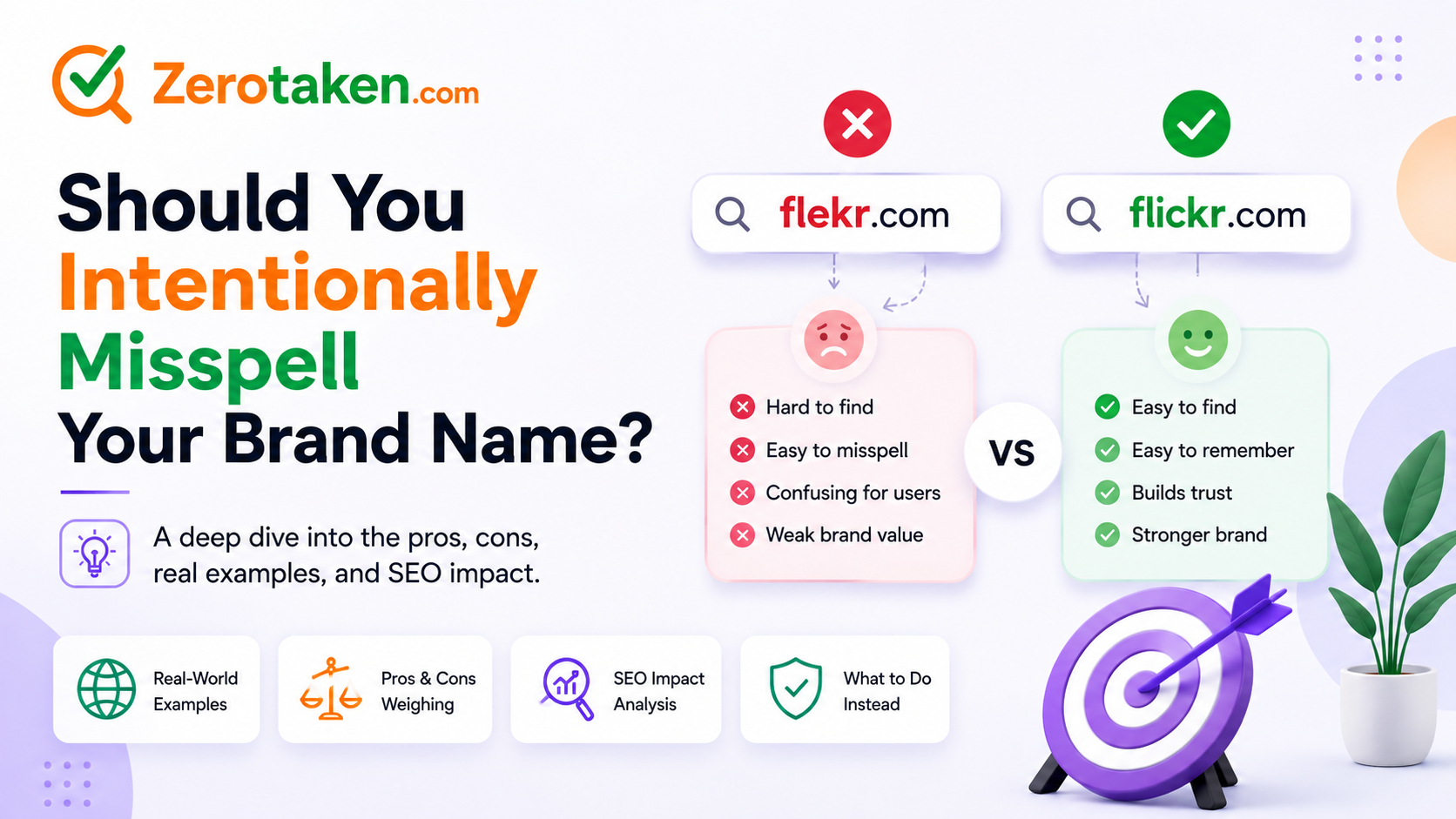
What counts as an intentionally misspelled brand name?
It's a name that respells a real word on purpose to make it ownable and distinctive. The most famous move is the dropped vowel — Flickr from flicker, Tumblr from tumbler, Scribd from scribed — but the family is bigger than that. Phonetic respellings swap letters for the same sound (Lyft for lift, Fiverr for fiver, Digg for dig). Doubled or added letters stretch a word into something registrable (Fiverr's second r, Reddit's doubled d). All of them share one trait: your ear hears a familiar word, but your fingers have to type something that fights spellcheck.
The distinction that matters isn't how clever the respelling looks on a slide — it's how a stranger reconstructs it. When someone hears your name once and reaches for a keyboard, a misspelled name asks them to remember not just the word but the specific way you broke it. That reconstruction cost, not aesthetics, is the entire subject of this decision. A misspelling that a listener can only spell one way is cheap; one that could be typed three ways is expensive, and you pay the difference forever.
Why are founders so tempted to drop a vowel?
Because it feels like it solves the hardest problem in naming for free. The correctly-spelled .com is gone — every good one has been for years — and a misspelling instantly reopens the whole dictionary. 'Lift' is unobtainable; 'Lyft' was wide open. For the price of one letter you get the meaning of a real word, a short brandable string, and a .com at standard registration price instead of five figures on the aftermarket. Framed that way it sounds like a steal.
It's also survivorship bias doing quiet damage. You know Flickr and Lyft precisely because they became huge, so the format looks blessed. You don't know the thousands of misspelled startups that died in obscurity while their founders spelled the name out loud at every meeting. The winners didn't win because of the missing vowel; they won despite it, on the back of huge brand-awareness budgets that eventually taught everyone the spelling. If you can't fund that teaching, you inherit the cost without the outcome.
So the temptation is real and the tactic is legitimate — but it's a trade, not a free win. The rest of this guide is about pricing the trade honestly before you make it, because unlike almost every other naming choice, this one is very hard to walk back once it's on your logo, your business cards, and ten thousand inbound links.
What does an intentional misspelling actually cost you?
The headline cost is the spelling tax, and you pay it on every single verbal exchange for the life of the company. Every podcast ad, every conference intro, every word-of-mouth referral now carries a mandatory 'that's F-I-V-E-R-R, two r's' clause. It never goes away and it never gets cheaper. The name that was supposed to save you money quietly bills you in friction on every conversation that isn't happening on a screen.
The second cost is leakage, and it's the one that actually loses revenue. When people hear 'Lyft' cold, a large share type 'lift.com' first — and if a competitor, a parked page, or a broker owns the correctly-spelled version, you just handed them your hard-won word-of-mouth traffic. You are, in effect, running permanent unpaid advertising for whoever owns the spelling everyone's instinct reaches for. That's why serious companies that go the misspelling route eventually spend heavily to acquire the correct spelling too; the leak is real enough to buy back.
The third cost is subtler: trust and perceived quality. A respelling that reads as 'grabbed the cheap version' can make an early-stage brand look scrappier than it is, especially outside tech circles where 'why is it spelled wrong?' is a genuine question, not an insider wink. In consumer, legal, health, or finance categories — anywhere buyers are already nervous — a name that looks misspelled can add hesitation exactly where you can least afford it.
When does a deliberate misspelling actually work?
It works when three conditions hold at once, and it backfires when any one of them is missing. First, the respelling has to be phonetically obvious — there can be only one sensible way to sound it out, and ideally only one way to spell what you hear. 'Lyft' works because nobody says it 'lift-y' or 'lyfft'; the sound maps cleanly. A respelling that changes or muddies the pronunciation isn't a clever misspelling, it's just a confusing name.
Second, you need exactly one plausible written form, not several. The danger isn't that people can't spell your name — it's that they can spell it multiple defensible ways and scatter across all of them. If a listener might reasonably type your name three different ways, you don't have a brand, you have a typo generator, and you'll spend years buying up the variants you didn't choose.
Third, you have to be planning to invest in brand awareness anyway. Misspellings win when repetition does the teaching — when enough people see the name written, often enough, that the odd spelling becomes the obvious one. That's a marketing budget and a few years talking. If you're bootstrapping and relying on organic word-of-mouth, you're choosing the format that punishes word-of-mouth the hardest. Match the name to how you'll actually grow, not to how the logo looks in Figma.
Which misspelling tactics are safe, and which are traps?
Not all respellings are equally risky. The safe ones preserve the sound and leave only one way to write what you hear; the traps quietly multiply the spellings people will try. Before you commit to any of them, say the name to five people who've never seen it and ask them to type it — the spread of what they produce is your real answer, not your own confidence in the cleverness.
- Safer: a single dropped vowel that doesn't change the sound (Flickr, Tumblr) — the ear still hears the real word
- Safer: a clean phonetic swap with one obvious reading (Lyft, Digg) — pronunciation is unmistakable
- Risky: doubling a letter people won't expect (is it Fiverr or Fivver or Fiver?) — invites variant confusion
- Risky: dropping a vowel that changes how it's pronounced — now it's a new, harder word, not a familiar one
- Trap: a respelling with two or more defensible spellings — you'll bleed traffic across all of them forever
- Trap: swapping in numbers or leetspeak (Gr8, 4u, Fyre) — fails the radio test and reads as low-trust
- Trap: misspelling a word people already struggle to spell — you've stacked two spelling problems into one name
Does a misspelled name hurt SEO, voice search, or AI discovery?
It doesn't hurt classic SEO in any direct way — the spelling of your brand isn't a ranking factor, and Google is perfectly happy to rank 'Flickr' for 'flickr.' If anything, a unique misspelling is easier to rank for as a brand query precisely because nothing else competes for that exact string. The real cost was never the algorithm; it's the human on the other side of the search box typing the wrong thing.
Voice and AI are where the misspelling tax quietly compounds. Ask a smart speaker to 'open Lyft' and it has to transcribe a spoken sound back into your exact respelling — and if it lands on 'lift' instead, it sends the user somewhere else entirely. The same failure shows up when someone asks an AI assistant to 'find that Fiverr-type site' or when browser autocomplete guesses the dictionary spelling before yours. Every system that turns speech or intent back into text is a place your clever respelling can misfire, and there are more of those systems every year, not fewer.
The honest takeaway: a misspelled name isn't penalized, it's mis-transcribed. That's a different and arguably worse problem, because you can't fix it with content or links — you can only out-spend it with enough brand repetition that the machines and the humans both learn the odd spelling by heart.
What should you try before you knock the vowel out?
A misspelling should be a considered choice, not the first reflex when the .com is taken — and there are usually better moves. Coin a genuinely new word instead of breaking a real one: Twilio, Vercel, and Kajabi are invented from scratch, which gets you an available .com with none of the 'wait, how's that spelled?' baggage, because there's no correct spelling to compete with. Or build a clean compound of two common, unmistakably-spelled words — Salesforce and Squarespace own their .coms without asking anyone to remember a dropped letter. Both routes solve the availability problem without signing you up for the lifetime spelling tax.
If your heart is set on the specific correctly-spelled word, price the alternatives honestly before you respell around it: a different extension on the exact word you want, or simply making an offer on the taken .com, can cost less over five years than the leakage and awareness spend a misspelling quietly demands. The point is to compare the real total cost of each path, not to treat the free-looking misspelling as automatically cheapest — it usually isn't.
Whichever direction you lean, resolve availability across your whole shortlist in one sitting before you fall in love with any single name. ZeroTaken is built for exactly that sweep — describe the idea, get brandable coined words, clean compounds, and respelling options side by side, and check real-time .com, .io, and .co availability for all of them at once, without your best candidates being logged and resold to a broker. Seeing which names you can actually own, cleanly spelled, is often the fastest cure for the urge to misspell.
So — should you misspell your brand name or not?
Default to no. Reach for an intentional misspelling only when the respelling is phonetically obvious, has exactly one defensible written form, and you have the awareness budget to teach it — and even then, treat it as a deliberate trade you're choosing with eyes open, not a free way around a taken .com. When those conditions genuinely hold, a clean single dropped vowel or an unmistakable phonetic swap can give you a short, ownable, memorable brand; that's the Flickr and Lyft outcome, and it's real.
But if the respelling could be typed more than one way, changes how the word sounds, leans on numbers or leetspeak, or is the thing standing between a bootstrapped team and word-of-mouth growth, don't do it — coin a new word or build a clean compound instead. The failure mode is always the same: a name a stranger can't reliably type after hearing it once loses customers to typos, to the correctly-spelled competitor, and to every voice assistant that guesses the dictionary. Pick a name you can own and spell in the same breath, verify the .com is actually free, and get back to building the thing the name is for.