
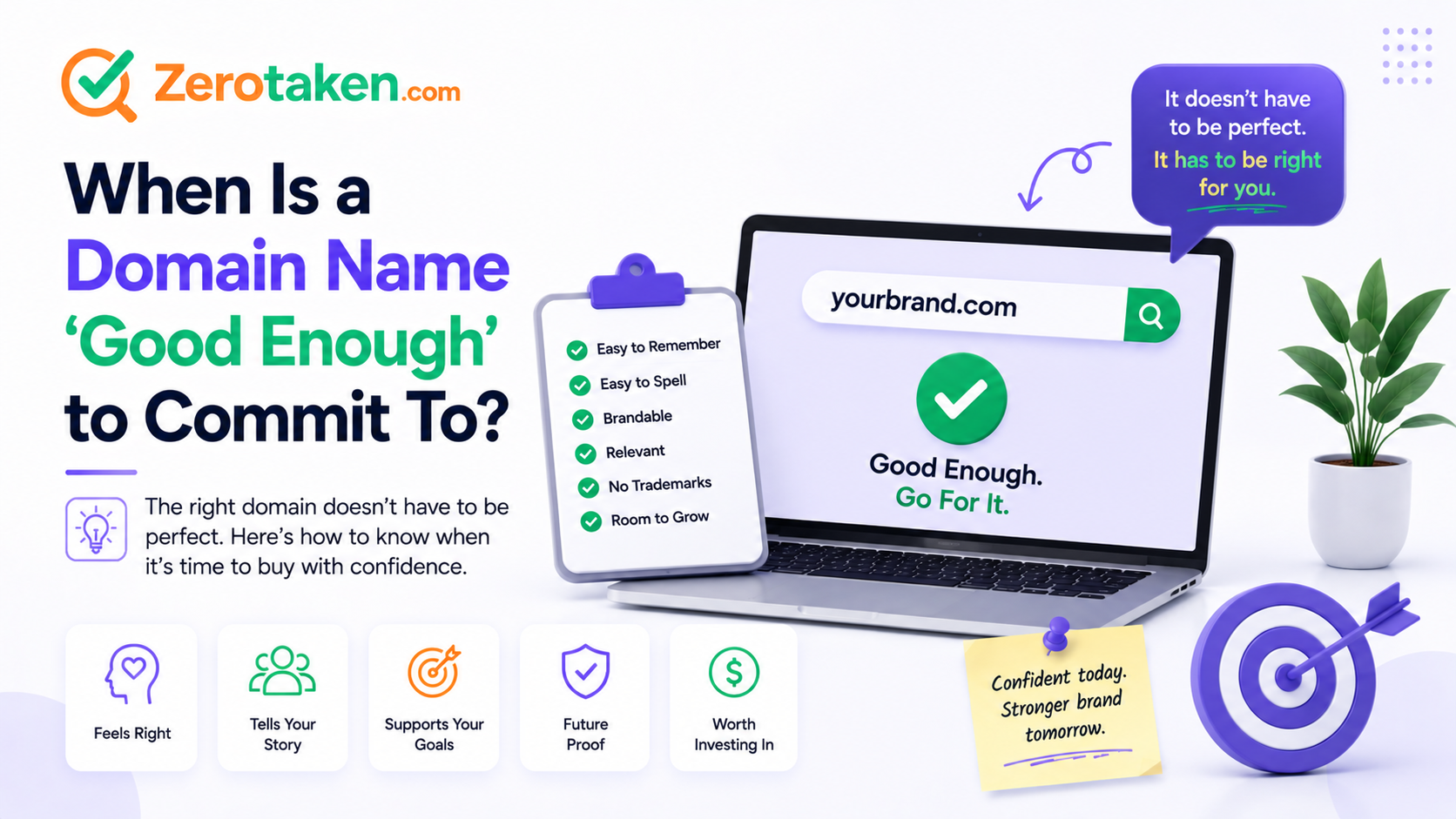
When Is a Domain Name 'Good Enough' to Commit To?
You have a shortlist. Four or five names, every one of them decent, and you've been staring at them for three days unable to pull the trigger. Each candidate has a small flaw — this one's a syllable too long, that one's only free on .io, the other one is fine but doesn't give you goosebumps — so you keep the tabs open and keep generating more, certain the perfect name is one more search away. It isn't. The perfect domain is a myth that costs real founders real weeks, and the skill that actually matters isn't finding a better name — it's knowing when the one in front of you is already good enough to buy and move on. This guide is the honest threshold: what 'good enough' really means, which of your dealbreakers are fake, why the perfect name doesn't exist, and a rule for committing today instead of next month.
Why do founders get so stuck choosing a domain name?
Because the domain is the first decision that feels irreversible, and it's the one creative choice a technical founder can obsess over instead of writing code. Everything else in the early days is provisional — you'll rewrite the landing page, pivot the pricing, redo the logo twice — but the name feels like it gets stamped on the company forever, so the stakes feel enormous even when they aren't. That perceived permanence is what turns a two-hour task into a two-week spiral.
The search itself makes it worse. Every naming tool can generate infinite alternatives, so there is always one more batch to check, and each new list plants the doubt that the great one is in the next round. This is bikeshedding with a domain registrar: the decision is small enough that everyone has an opinion and visible enough that it feels important, so it absorbs energy far out of proportion to its actual weight. Meanwhile the product that the name is supposed to point at doesn't exist yet.
Here's the reframe that unsticks most people: the name does not make the company, the company makes the name. Nobody thought 'Google' or 'Kajabi' or 'Zapier' was a good name the first time they heard it — those strings earned their meaning by having a real product behind them. You are trying to pre-load a feeling into the name that only the next two years of work can actually put there. Accept that, and 'good enough' stops being a compromise and starts being the correct target.
What does 'good enough' actually mean for a domain?
Good enough means the name clears a short list of genuine non-negotiables and carries no active liabilities — that's the whole bar. It does not mean the name thrills you, wins a poll of your friends, or matches the mental image you had before you started. A name can be completely serviceable and still feel a little flat on day one; flat is fine, flat becomes familiar, and familiar becomes 'obviously the right choice' within about a week of using it.
The mistake is treating 'good enough' as a synonym for 'settling.' It isn't. Settling is buying a name with a real defect — one nobody can spell, one that collides with a trademark, one that reads badly out loud — because you're tired of looking. Good enough is the opposite discipline: it's refusing to reject a clean, ownable, sayable name over a preference that won't matter in six months. The difference between those two is the entire subject of this guide, and getting it wrong in either direction is expensive.
So the working definition is blunt. A domain is good enough the moment it passes every non-negotiable and you can't name a concrete way it will actively hurt you — not a way it fails to delight you, a way it will cost you customers, trust, or legal peace. If you can't articulate a real harm, what you have is a preference, and preferences are not a reason to keep the tabs open.
Which criteria are actually non-negotiable?
There are only a handful of things a domain genuinely must do, and every one of them is about avoiding a concrete future cost, not chasing an upside. If a name clears all of these, it is a legitimate candidate — full stop. If it fails even one, no amount of how-it-feels can rescue it, and you should cross it off no matter how much you like the sound.
Run each finalist against exactly this list, and treat everything not on it as a tiebreaker rather than a gate:
- The radio test: say it out loud once and a stranger can type it correctly, with no screen — no 'is that one word or two,' no ambiguous spelling, no letters-vs-numbers guessing
- Clean legal footing: no obvious trademark collision with an existing company in your category, and it isn't someone else's well-known brand with a different extension
- Actually registrable now: the exact name is available to buy today on a credible extension (.com first; .io, .co, or .ai are fine for the right audience) — not 'available' on a broker's page for five figures
- No unfortunate readings: it doesn't accidentally spell something else when the words run together, and it reads cleanly in the languages of the markets you'll sell in
- Not actively painful: it isn't so long people truncate it, and it doesn't lean on hyphens, doubled letters, or leetspeak that you'll be spelling out forever
Which of your 'dealbreakers' are actually fake?
Almost every stuck founder is stuck on a criterion that feels essential and isn't. The biggest one is the extension. You do not need the .com to succeed — a generation of respected companies runs on .io, .co, .ai, and .dev, and your customers will type whatever is on your button. The .com is a nice-to-have that becomes a genuine dealbreaker only if a live competitor owns it, or if you're building for a mainstream, non-technical audience who will reflexively type .com. Outside those two cases, rejecting an otherwise-perfect name because the .com is taken is optimizing for a habit your users don't have.
The second fake dealbreaker is keyword content. Founders agonize over whether the name 'says what we do,' but a descriptive name is a marketing convenience, not a requirement, and it stops mattering the instant your brand becomes the thing people search for. Nobody needs 'Stripe' to contain the word 'payments.' The third is length-perfectionism — the belief that you must have the shortest possible string. Short is good; one syllable shorter is not worth another week, and a clean two-word compound beats a cryptic five-letter coinage that nobody can spell.
The last and most seductive fake criterion is the feeling — the conviction that the right name will arrive with a little jolt of certainty. It usually won't. Certainty is manufactured after the fact by using the name, not discovered in a generator. If you're holding out for goosebumps, you've swapped a solvable problem (find a clean, ownable name) for an unsolvable one (find a name that feels like destiny before the company exists), and you can search forever without ending that quest.
Is there actually such a thing as the perfect domain?
No — and believing there is, is the single most expensive idea in naming. Perfection implies a name with zero tradeoffs, and every real name is a bundle of tradeoffs: the memorable ones are often longer, the short ones are often coined and unfamiliar, the descriptive ones age badly when you expand, the .com is taken or costs a car. There is no candidate that wins on every axis, because the axes pull against each other. What you're actually choosing among is a set of different, roughly-equal compromises, and paralysis is what happens when you refuse to admit that's the real menu.
Look at the names you consider obviously great and you'll find they were all 'good enough' on day one. 'Amazon' had nothing to do with books. 'Uber' was a strange word choice. 'Figma,' 'Notion,' 'Vercel' — none of them arrived pre-loaded with the meaning they carry now. They became perfect-in-hindsight because the companies behind them shipped, and the name absorbed the reputation of the work. That's the actual mechanism: quality flows from the product to the name, never the other way around. A name you'd call boring today is one launch away from sounding inevitable.
This is genuinely freeing once it lands. If perfect doesn't exist and greatness is retroactive, then the return on searching drops to roughly zero the moment you have a clean, ownable candidate. Every additional hour is spent chasing a difference that your customers will never perceive and that the next two years of building will erase anyway. The perfectionism isn't protecting you from a bad outcome; it's just delaying a fine one.
What's a simple rule for knowing when to stop looking?
Use a threshold plus a timer. The threshold: the moment you have two names that both clear every non-negotiable, you are done searching for candidates — you now have a choice to make, not a search to continue. The timer: give the final pick a hard deadline, measured in hours, not weeks. Naming expands to fill whatever time you give it, so the only reliable way to stop is to refuse to give it more. A shortlist by end of day, a decision by the next morning, is a completely sufficient process for a decision this size.
When you're choosing between finalists that all pass the bar, don't re-litigate them on feel — apply cheap tiebreakers in order and take the first winner. And weigh the real cost of continuing against the real prize: another week of searching might, at best, upgrade you from your third-favorite name to your first, and the gap between those two is invisible to every customer you'll ever have. One shipped week is worth more than the best name on your list. Founders consistently overvalue the marginal name and undervalue the weeks the search is quietly eating.
Concretely, break a tie like this and then commit:
- Pick the one a stranger spells correctly the most often when you say all the finalists out loud — spellability compounds forever
- Then prefer the one with room to grow — a name that won't box you in if the product expands beyond its first feature
- Then prefer the better extension situation (exact .com free, or a clean .io/.co for a technical audience)
- Still tied? Flip a literal coin — if two names are genuinely indistinguishable on every real criterion, the choice doesn't matter, and the coin proves it by showing you which one you were secretly hoping it would land on
How do you commit to a name without regret?
Buy it the same day you decide, before the doubt has time to reopen the search. A registered domain is a small, low-stakes commitment — the cost of being wrong is a few dollars and a redirect, not a catastrophe — but the psychological act of owning it is what actually ends the spiral. As long as the name is unbought, it stays a hypothesis you can second-guess; the moment it's in your account it becomes a fact you build around, and your brain quietly stops shopping. Purchase is the off-switch for the loop.
Do two things at checkout so you never have to revisit the decision defensively. Grab the obvious variants you'd hate a competitor or squatter to own — the matching .com if you bought the .io, the plural or singular, maybe the most likely typo — and point them all at your primary. It's a few dollars of insurance that removes the 'but what if' that otherwise nags you back into the tabs. Then close every naming tab, tell someone the name out loud as if it's already decided, and go back to building. Saying it as a settled fact is how it starts feeling like one.
The only real regret protection is speed of execution, not perfection of choice. Before you commit, run your final two or three through one honest availability sweep so you're deciding on names you can actually own today, not names a broker will quote you five figures for. ZeroTaken is built for exactly that last step — describe the idea, get a batch of clean, brandable candidates, and check real-time .com, .io, .co, and .ai availability across the whole shortlist at once, so the finalists in front of you are all genuinely buyable. Deciding between real, ownable options is a five-minute job; agonizing over names you were never going to get is what eats the week.
So — when is a domain name good enough?
It's good enough the moment it passes the radio test, has clean legal footing, is registrable today, carries no unfortunate readings, and isn't actively painful to type or say — and you can't name a concrete way it will hurt you. That's the entire bar. If a name clears it, the correct next action is not another search; it's a purchase. Everything past that line is preference dressed up as diligence, and preference is not worth the weeks it's costing you.
The founders who name well aren't the ones with better taste; they're the ones who set a real bar, stopped at the first clean name that met it, bought it, and put their remaining energy into the product that would eventually make the name look inevitable. Do the same. Pick the good-enough name in front of you, verify you can actually own it, register it today, and get back to the only thing that will ever make the name feel perfect — building something worth typing it for.