
What Is a Premium Domain — and Should You Ever Pay for One?
You run a search, the name is free, and then you see it: $2,499 a year. Not a typo, not an auction — the registrar is quoting that as the standard price to register a name nobody else owns. Welcome to premium domains, one of the most confusing corners of the whole naming process, because the word 'premium' gets slapped on two completely different things and the pricing hides a trap that doesn't reveal itself until renewal. Most founders either panic and overpay for a name that isn't special, or dismiss the whole category and miss the rare case where it's a genuinely smart buy. This guide draws the line: what makes a domain premium, why the number is what it is, and the honest test for whether you should ever pay it.
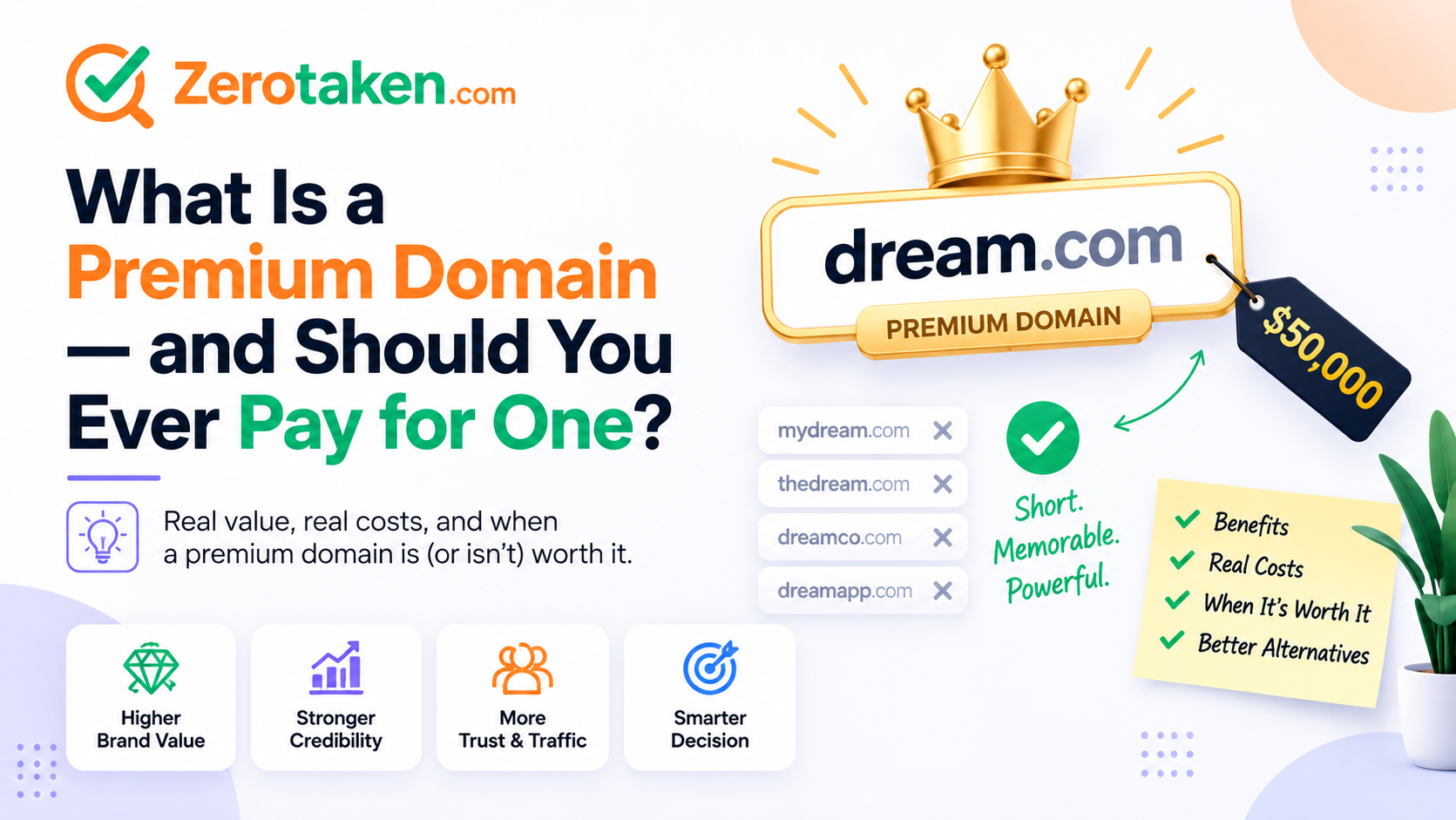
What actually makes a domain 'premium'?
The trap is that 'premium' means two unrelated things, and telling them apart is the first move. The first kind is a registry premium: the company that runs the extension — Identity Digital for .ai and .io-adjacent zones, Radix for .online and .store, and so on — has looked at an unregistered name, decided it's valuable, and set a permanent higher price on it. Nobody has ever owned it. It's free in the sense that it's available, but the registry has pre-priced it at anywhere from $80 to five figures a year. This is why a name you invented five seconds ago can cost $3,000: an algorithm flagged the keyword before you ever typed it.
The second kind is an aftermarket 'premium' — a name someone already owns and parked on a marketplace like Sedo, Afternic, or Dan.com with a 'premium' label and a for-sale price. That's just a resale, and the 'premium' badge is marketing, not a category. The distinction matters enormously: a registry premium is a recurring annual price you'll pay forever, while an aftermarket premium is a one-time purchase from the current owner after which the name renews at the normal $10-ish rate. Before you react to any big number, find out which of these two you're looking at.
Why is this domain marked premium and priced so high?
For registry premiums, the pricing is almost entirely about the string, not you. Registries run every unregistered name in their zone through a valuation model and tier it: short names, real dictionary words, high-search keywords, and category-defining terms (think pay.ai, cloud.io, loans.online) get bumped into premium bands. The newer and more marketable the extension, the more aggressively this happens — .ai in particular has huge swaths of its good inventory sitting behind premium pricing because demand has been ferocious and the registry knows it.
The logic is pure supply and demand: there's exactly one bank.ai, thousands of people would want it, so the registry captures that scarcity as a recurring fee instead of letting the first person register it for $10 and flip it. That's rational for them, but it means the price reflects the theoretical value of the keyword to the entire market — not its value to your specific, unlaunched project. You are being quoted the ceiling, and treating that number as a signal of quality is exactly the mistake the pricing is designed to provoke.
Does a premium price mean the domain is actually better?
No — and this is the belief that empties bank accounts. A premium price tag measures keyword demand and registry greed, not brand quality, and it does nothing for your SEO. Google has said plainly and repeatedly that it does not care what you paid for a domain or whether the registry tiered it as premium; an exact-match keyword domain is not the ranking shortcut it was a decade ago. Paying $2,000 for insurance.io buys you a generic keyword, not a moat and not a rankings boost.
In fact, generic premium keywords often make weaker brands than invented names. 'Stripe,' 'Notion,' 'Figma,' and 'Vercel' are all cheap, unremarkable registrations that became worth billions because the company made the word mean something — the domain didn't cost a premium because the word was made up. A distinctive coined name you own outright almost always beats a costly, forgettable dictionary keyword you're effectively renting. The premium buys recognizability today; a good invented brand builds it and keeps it.
What's the renewal trap most people miss?
Here is the single most important thing about registry premiums, and the checkout page rarely spells it out: the premium price is usually the renewal price too, every year, forever. That $2,499 isn't a one-time gate you clear to 'own' the name — it's your annual bill, and it typically doesn't reset to the standard rate when you renew or even when you transfer the domain to another registrar. The premium is attached to the name at the registry level and follows it around.
Do the math before you fall in love. A $2,000/year premium is $10,000 over five years and $20,000 over ten — for a domain, not a product. Miss a renewal because you forgot the bill was that big, and the name drops back into premium inventory for the next person, not back to you at $10. Compare that to a clean invented .com at roughly ten dollars a year, and the premium has to be doing something genuinely irreplaceable to justify a four-figure recurring line item on a business that may not exist in eighteen months.
- Confirm the renewal price, not just the first-year price — they're usually the same premium number.
- Check whether transferring registrars drops the premium (it almost never does).
- Multiply the annual fee by 5 and 10 years — that's the real cost you're signing up for.
- Budget for the fact that a missed premium renewal means losing the name back to the registry, not a cheap re-registration.
When is paying for a premium domain actually worth it?
There is a real case, and it's narrower than the marketing implies. Paying a premium makes sense when you're an established, revenue-generating business, the exact name is strategically central rather than nice-to-have, and the number is small relative to what that name earns or protects. A funded fintech that will spend six figures on brand and paid acquisition can rationally pay a few thousand a year for the category-defining keyword its entire marketing will point at — the domain fee is a rounding error against the campaign, and owning the obvious name genuinely lowers acquisition cost.
The other legitimate case is a one-time aftermarket premium on a short, clean name that then renews at the standard rate. Buying a great two-word .com from its current owner for a few thousand dollars, once, with normal renewals afterward, is a very different financial decision from committing to a recurring registry premium — it's a capital purchase of an asset you fully control, not a perpetual lease. If the name is exceptional and the future renewals are cheap, that can absolutely be worth it.
When should you walk away and just generate an alternative?
Walk away in almost every pre-launch situation. If you're pre-revenue, still validating the idea, or bootstrapping, a recurring four-figure domain bill is a bet you can't yet justify — you're paying for a keyword's theoretical value with money you don't have, on a venture whose name might change before it ships. The premium is the registry's problem to solve, not yours. Solve it by picking a name that was never premium in the first place.
That's the quiet advantage of a coined, brandable name: registries don't tier invented words as premium, because their models are hunting for real keywords and dictionary terms. A made-up name lands in standard pricing by default, which is exactly why the strongest modern startups run on cheap, unusual .coms. When a premium price wall stops you, the fix is almost never to pay it — it's to generate ten better names that don't have one. ZeroTaken exists for exactly this moment: describe the idea, get brandable names, and see which are actually free at the normal price instead of staring at a $3,000 keyword.
How do you tell a fair premium from an overpriced parking page?
For registry premiums there's no negotiation — the price is the price, set by the zone operator, and your only real evaluation is the renewal math above. Your leverage is choosing a different name or a different extension, not haggling. If .ai wants a premium for the keyword, the same idea on a standard-priced name almost always exists a few generations away in a name generator.
For aftermarket 'premium' listings, do sanity-check the number, because 'premium' there is a seller's opinion. Look at who's selling and whether the name is actually developed or just parked; search comparable recent sales on marketplaces to see whether the ask is in the same universe as reality; and remember that a parked page demanding five figures for a mediocre name is not a market price, it's a hopeful one. Many marketplace 'premiums' are speculators who paid $10 and slapped three zeros on it — you're free to counter low or ignore them entirely. And whatever the source, re-verify live availability before you pay: a 'for sale' banner is not the same as a name that's genuinely registrable, and confirming that is the step people skip right before they overpay.
So, should you pay for a premium domain?
Almost never before you have a business, and only deliberately after you do. A premium price is a measure of a keyword's demand across the whole market, not a verdict on how good the name is for you — and for a registry premium, it's a recurring bill that quietly compounds into thousands of dollars for a string of letters. The founders who get burned treat the big number as proof the name is special; the ones who don't treat it as the registry's asking price and simply decline.
So run the test every time: is this a one-time aftermarket buy or a forever renewal, is the business real enough to justify the recurring cost, and is the name so uniquely valuable that no invented alternative would do? If any answer is shaky, walk. A distinctive, standard-priced name you own outright will out-perform a rented keyword nine times out of ten — and the tenth time, you'll be a real company that can actually afford it.